
The global rail wireless investment wave and why planning quality mattersThe global landscape of transportation is undergoing a digital metamorphosis, driven by a massive surge in rail wireless investment. As nations race to modernize infrastructure through high-speed connectivity, IoT integration, and automated signaling, the stakes for these capital-intensive projects have never been higher. However, the sheer scale of this “investment wave” brings a critical caveat: technological ambition without meticulous foresight is a recipe for systemic inefficiency. To truly capture the value of next-generation connectivity, stakeholders must recognize that planning quality is the ultimate differentiator between a fractured network and a seamless, future-proofed transit ecosystem. This exploration delves into the drivers behind the current funding boom and why the precision of early-stage strategic design is the most vital factor in ensuring long-term operational excellence.
The Unique Challenge — why rail wireless is fundamentally different from conventional wireless planningUnlike standard cellular or enterprise Wi-Fi planning, rail wireless environments present a volatile cocktail of physical and technical hurdles that defy conventional network logic. While typical wireless planning assumes relatively stationary users or predictable pedestrian speeds, rail systems must maintain high-throughput connectivity for assets moving at speeds of up to 350 km/h, necessitating near-instantaneous handovers between base stations. The physical geography is equally unforgiving; signals must penetrate deep tunnels, navigate “urban canyons” of steel and concrete, and remain stable across vast, remote stretches of track where power and backhaul are scarce.
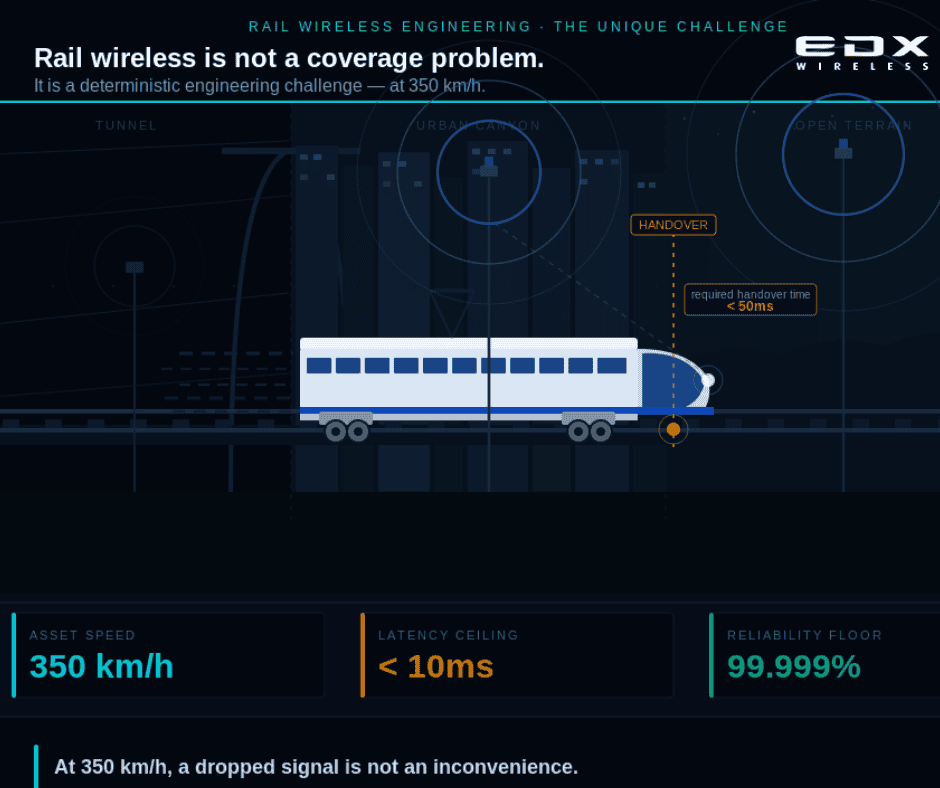
Furthermore, the safety-critical nature of rail operations—where a minor signal lag can impact braking systems or train separation—demands a level of “five-nines” reliability and low latency ($<10ms$) that far exceeds the requirements of public consumer networks. Consequently, rail wireless is not merely about coverage; it is a high-stakes exercise in deterministic engineering within a highly dynamic environment.
PTC220 Use Case
220 MHz positive train control in North America, route studies, Cirrus terrain data for regulator-ready submissions.
The implementation of Positive Train Control (PTC) in North America represents one of the most rigorous deployments of the 220 MHz spectrum in the world, serving as a benchmark for safety-critical rail wireless. Tasked with preventing train-to-train collisions and over-speed derailments, this use case demands exhaustive route studies to ensure continuous signal coverage across incredibly diverse topographies.To meet the stringent “regulator-ready” standards required for federal submissions, planners rely on high-fidelity Cirrus terrain data.
This high-resolution geo-data allows for the precise modeling of signal propagation, accounting for every ridge, valley, and man-made obstacle that could interrupt the 220 link. By integrating this granular data into the planning phase, North American rail operators can validate their network designs with a level of accuracy that satisfies both operational safety needs and strict regulatory oversight, ensuring that the PTC backbone remains resilient in the most challenging geographical corridors.
Kavach Use Case
India is currently witnessing a paradigm shift in railway safety through the Kavach (meaning “Armor”) initiative—a massive, indigenously developed Automatic Train Protection (ATP) revolution. With a colossal investment scope exceeding ₹12 billion for recent backbone upgrades and an overall modernization umbrella sanctioned at ₹27,693 crore, Indian Railways is aggressively scaling the system to eliminate human error across its high-density corridors.
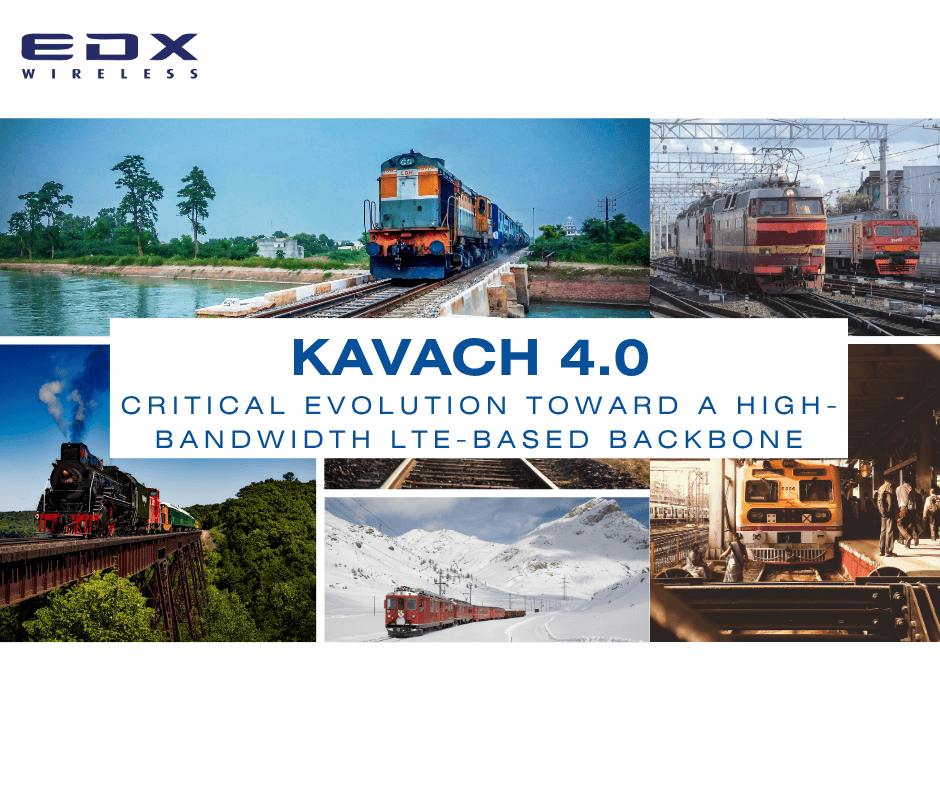
The transition to Kavach 4.0 marks a critical evolution from legacy UHF radio toward a high-bandwidth LTE-based backbone, a move essential for supporting the real-time data demands of a network that handles millions of passengers daily. However, the rollout faces the unique “terrain gauntlet” of the Indian subcontinent—ranging from the dense, signal-absorbing tropical forests of the South to the high-altitude, rocky passages of the North and the complex, metal-heavy “interference jungles” of major metropolitan yards. Successfully deploying Kavach 4.0 requires more than just hardware; it demands sophisticated signal modeling that can account for these diverse geographical extremes, ensuring that the “Armor” remains impenetrable regardless of the landscape
Automated Site Placement & ROI
In the context of the massive Kavach rollout across the Indian subcontinent, the financial and operational stakes of infrastructure placement are immense. Automated Site Placement (ASP) leverages sophisticated algorithms to solve the “Goldilocks problem” of rail wireless: ensuring enough towers for total safety-critical coverage without overbuilding costly, redundant hardware.
The Efficiency of Algorithmic Precision
Traditional manual planning often relies on “rule of thumb” spacing, which frequently leads to over-engineering in flat areas and signal gaps in complex terrain. ASP, however, analyzes thousands of permutations across the track centerline to find the mathematical minimum number of sites required to maintain the required signal threshold. By intelligently utilizing high points in the terrain and optimizing antenna heights, the software eliminates unnecessary “filler” sites that offer diminishing returns on coverage.
The 500 km Value Case
To understand the impact at scale, consider a typical 500 km high-speed or high-density corridor:
- Manual Planning Baseline: A typical manual approach might place towers every 5 km to be “safe,” totaling 100 sites.
- Automated Optimization: An ASP engine, accounting for specific 700 MHz or 220 MHz propagation characteristics, might determine that only 82 sites are actually needed to maintain a 99.999% availability link.
- The Cost Delta: At an estimated cost of $250,000 to $400,000 per site (including civil works, power backhaul, towers, and LTE/Kavach hardware), saving 18 sites results in a direct CAPEX reduction of $4.5 million to $7.2 million.
Long-Term ROI: Beyond CAPEX
The savings extend far beyond the initial build. Every site eliminated by automated placement represents a permanent reduction in OPEX, including:
- Maintenance: Fewer physical locations for technicians to visit and inspect.
- Leasing/Power: Lower recurring costs for land usage and electricity.
- Network Complexity: A leaner network has fewer “handover” points, which statistically reduces the likelihood of dropped connections at high speeds—directly improving the reliability of the ATP system.
By shifting from “estimate-based” to “data-driven” placement, rail operators ensure that every rupee of the ₹12 billion+ investment is mapped to maximum safety and performance.
Coverage Compliance — FRA (US) and RDSO (India) regulatory requirements, and how SignalPro supports documented submissions
To transition from design to deployment, rail operators must navigate the strict oversight of national safety bodies. SignalPro acts as a bridge between engineering ambition and Coverage Compliance, providing the specific datasets and reporting formats required by the Federal Railroad Administration (FRA) in the US and the Research Designs and Standards Organisation (RDSO) in India.
Streamlining FRA (US) & RDSO (India) Submissions
Regulatory bodies do not just require a “working” network; they demand proof of reliability under worst-case scenarios.
- FRA Requirements: For PTC deployments, the FRA mandates exhaustive documentation showing that the 220 signal maintains a specific reliability threshold (typically $99.9\%$) across every meter of mandated track. SignalPro’s Regulatory Module automates the generation of these route-wide reliability grids, ensuring that the technical data matches the legal “Order of Particular Applicability.”
- RDSO Standards: In India, the Kavach rollout must adhere to SIL-4 (Safety Integrity Level 4) standards and RDSO’s specific signal-to-interference requirements. SignalPro supports these by providing precise Monte Carlo interference analyses and “best-server” maps that prove the LTE or radio backbone can withstand the subcontinent’s high-density signal environments.
Documented Submissions and “Audit-Ready” Reports
The Regulatory Module eliminates the manual labor of formatting complex RF data for government review. It provides:
- Automated Compliance Reporting: Instantly identifies “dead zones” or areas of non-compliance where signal levels fall below the regulator’s mandated dBm threshold.
- High-Resolution Geo-Data Validation: By using Cirrus terrain data, SignalPro produces “regulator-ready” submissions that are difficult to challenge, as the underlying topography is validated at a granular level.
- Archivable Design History: Every submission includes a complete digital audit trail—from the initial propagation model coefficients to the final automated site placement—ensuring that if a safety audit occurs years later, the original design logic is fully transparent and defensible.
In short, SignalPro transforms regulatory filing from a bottleneck into a standardized, high-speed workflow, ensuring that the path to Kavach or PTC certification is as seamless as the network itself.
Beyond Train Control — CCTV, TETRA/P25/LTE comms, IoT, trackside monitoring, and the integrated approach for Kavach’s LTE migration
While the primary driver for rail wireless is often the immediate need for safety systems like PTC or Kavach, the infrastructure being built today serves as a “digital backbone” for a multitude of secondary services. A unified, high-bandwidth network—particularly through the migration to LTE/FRMCS (Future Railway Mobile Communication System)—transforms a railway from a simple transport line into a data-rich, intelligent ecosystem.
The Multi-Service Digital Corridor
By shifting away from fragmented, single-use radio systems and toward an integrated approach, rail operators can leverage their wireless investment for several critical use cases:
- Real-Time CCTV & Security: Modern rail safety extends beyond the tracks to the passengers. High-speed LTE/5G allows for the live streaming of high-definition onboard and station CCTV directly to a centralized command center, enabling rapid response to security incidents or medical emergencies.
- Mission-Critical Voice (TETRA/P25/MCPTT): While legacy systems like TETRA and P25 have long provided reliable voice, the migration to Mission-Critical Push-To-Talk (MCPTT) over LTE allows for seamless, prioritized voice communication between drivers, maintenance crews, and dispatchers on a single device that also handles data.
- Massive IoT & Trackside Monitoring: Thousands of sensors—monitoring everything from track temperature and rail stress to the health of wayside signals—require a network that can handle high device density. This “Predictive Maintenance” model uses IoT data to identify potential rail fractures or equipment failures before they cause a service disruption.
- Onboard Connectivity: Beyond operations, the same infrastructure can support passenger Wi-Fi and infotainment systems, significantly enhancing the passenger experience and driving ridership.
The Kavach LTE Migration: An Integrated Blueprint
India’s Kavach 4.0 transition is a prime example of this integrated philosophy. Rather than deploying a narrow-band radio system solely for ATP, the move to LTE creates a unified pipe for all railway data.
In this integrated approach, the network must be designed with Quality of Service (QoS) slicing. This ensures that safety-critical Kavach data always receives the highest priority and lowest latency, while “best-effort” data like CCTV or telemetry uses the remaining bandwidth. SignalPro’s ability to model multiple technologies simultaneously is vital here; it allows planners to simulate how an LTE network will perform under the heavy load of simultaneous Kavach signaling, voice comms, and video feeds.
The “Single Pane of Glass” Advantage
The ultimate goal of this migration is to move away from “Siloed Planning”—where CCTV has one network and signaling has another—toward a Single Network Strategy. This integrated approach:
- Reduces Equipment Footprint: Fewer antennas and towers are needed when one LTE site handles multiple services.
- Centralizes Management: Troubleshooting and security patches are applied to one cohesive network.
- Future-Proofs the Subcontinent: As India’s rail traffic grows, the LTE backbone can be scaled or sliced to accommodate future innovations like 5G or autonomous train operations without requiring a total infrastructure rebuild.
Conclusion: Precision as the Foundation of Progress
As the global rail industry stands at the precipice of a digital era, the move toward systems like PTC and Kavach represents more than just a technological upgrade—it is a total commitment to passenger safety and operational resilience. However, the multi-billion dollar scale of these wireless investments leaves no room for “best-guess” engineering. The success of these networks hinges entirely on planning quality; without the precision of automated site placement, high-fidelity terrain data, and rigorous regulatory modeling, even the most advanced LTE backbone risks inefficiency and signal vulnerability. By prioritizing a data-driven, integrated approach to design today, rail operators do more than just meet compliance—they secure a future-proofed infrastructure that will remain the safe, high-speed heartbeat of global transit for decades to come.